Hurricane Season Pest Proofing for Corpus Christi Homes
Storms relocate pests wholesale: upward, inward and into the driest structure on the street - yours.
Read the Guide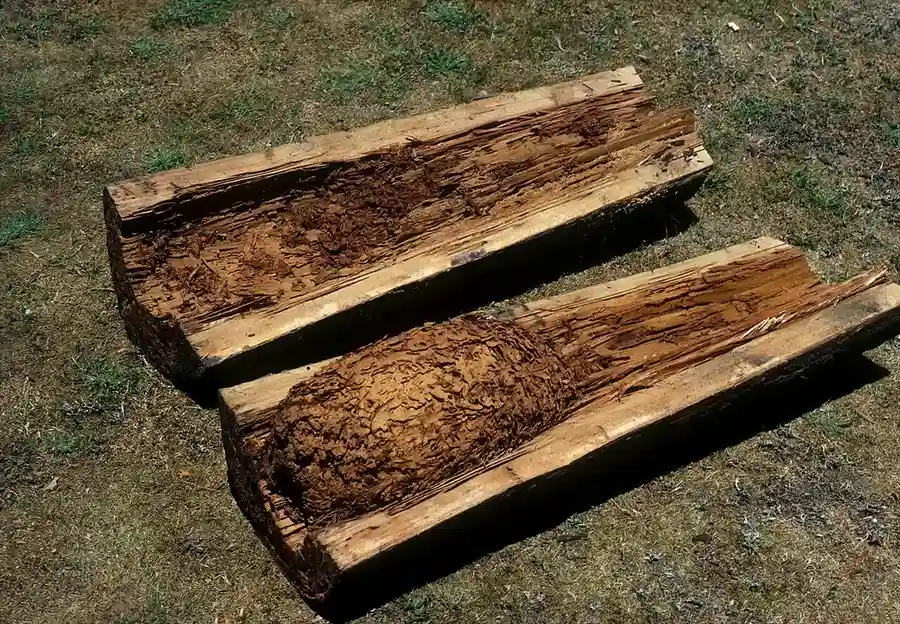
Formosan colonies run into the millions, nest inside walls, and damage wood far faster than native termites.
Problem: Formosan colonies run into the millions, nest inside walls, and damage wood far faster than native termites.
Solution: Inspect for the coastal signatures - carton nests, spring swarms, blistered paint - and treat both the soil and the wall nests.
When to call: Call at the first swarm indoors, any mud nest found in a wall, or soft and blistered wood in a Gulf Coast home.
Ask a Corpus Christi pest professional which pest they respect most and the answer is rarely the biggest or the fastest - it is the Formosan subterranean termite. Established along the Gulf Coast for decades, the Formosan runs colonies an order of magnitude larger than the native eastern subterranean, nests inside the structure it eats, and converts framing to honeycomb on a schedule that makes native termites look leisurely.
This is not a pest to fear, but it is one to take seriously and early. Formosan damage is a function of time more than anything else - the colony you find in its first season costs a fraction of the one that has been wall-nesting through three. What follows is how to tell the Formosan story from the native one, and what control looks like when the bigger cousin is the tenant.
Corpus Christi homeowners learn the pattern fast: palmetto bugs after a rain, fire ant mounds the morning after a storm, mosquitoes whenever the wind drops, and roof rats in the palms and oaks all year. Pest control here is not a one-time event; it is a rhythm matched to the Gulf Coast year.
Colony size is the headline: native subterranean colonies run to the tens or hundreds of thousands; Formosan colonies run to the millions, with foraging territories that can span a neighborhood block. The second difference is the nest. Native colonies live in the soil and commute to the wood. Formosan colonies build carton nests - chewed, cemented material that holds moisture - inside walls, roofs and trees, which means the colony can live in the house itself, partially or wholly independent of the ground.
The third difference walks on wings. Formosan swarmers are larger, honey-colored and swarm at dusk in late spring, drawn to lights in numbers that can coat a porch. Native swarmers fly in daytime earlier in the season by the hundreds. Either swarm deserves a call; a warm May evening with thousands of winged termites at the lights deserves a fast one.
Formosans favor the same conditions as everything else on the coast - moisture, warmth and wood in contact with wet ground - concentrated where the older city meets water. Older neighborhoods with pier-and-beam construction, chronic plumbing leaks, form boards and stumps left in the soil, and big old trees with carton nests in their cavities carry the densest pressure. Waterfront and near-bay districts add landscape timbers, docks and bulkheads to the menu.
Trees deserve a paragraph of their own. Formosans nest in living oaks and palms, hollowing heartwood while the tree leafs on, and a colony in a yard tree is a standing invasion force pointed at the house. Arborists and termite inspectors in Corpus Christi read the same trees with the same suspicion - cavities, carton material at the base, swarm history - for the same reason.
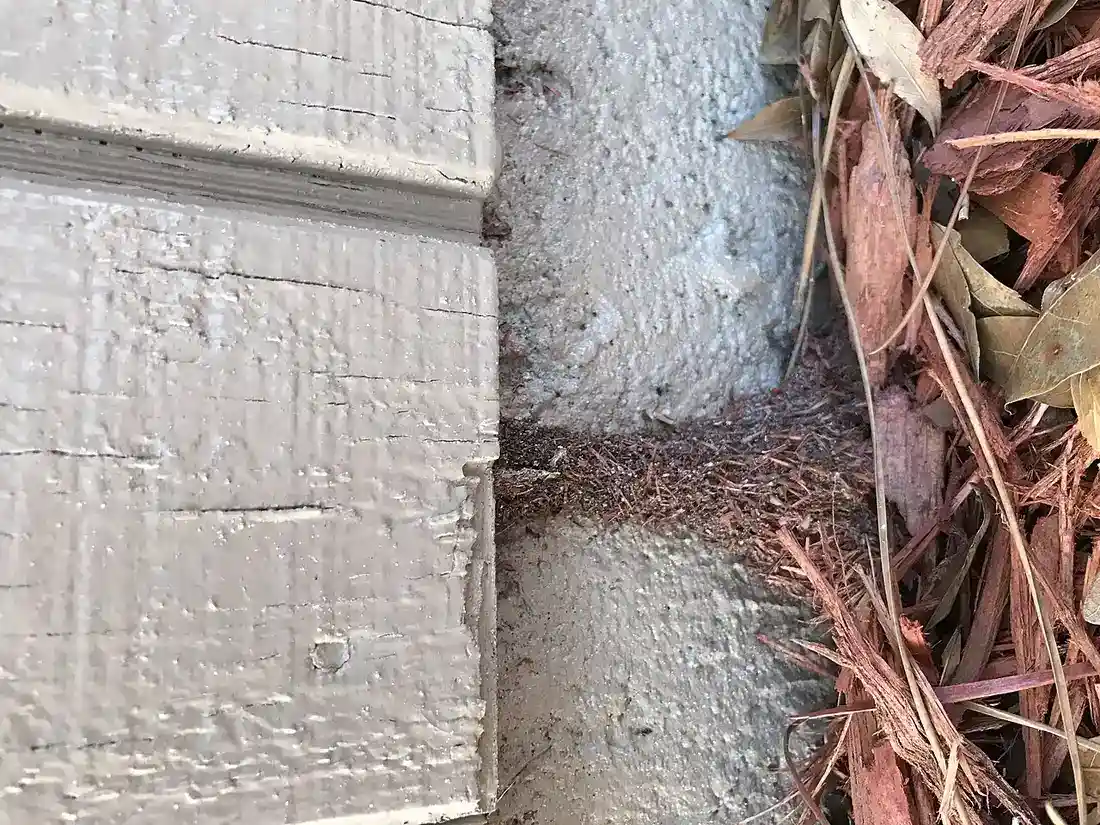

Carton is the signature: dark, spongy, soil-and-chew material packed into wall voids, attic corners or tree cavities, often with visible moisture. Behind painted drywall, a wall-nesting colony shows as blistered, bubbled or soft paint, sometimes with a faint sweet-sour smell; tapping the wall gives a papery hollow where studs should sound solid. Floors can feel spongy and doors stick as framing loses its section.
The seasonal sign is the swarm - and where it emerges matters as much as its size. Swarmers pouring from a baseboard, a window frame or a light fixture indoors mean the nest is in the structure, not the yard. Collect specimens in a jar with a little alcohol, note the date and the room, and keep the discovery exactly as you found it for the inspector. That jar and that note are worth real money in diagnostic time.
Two battlefields, because the colony lives in two places. The soil perimeter gets its barrier or baiting program as with natives; the wall nests get located and treated directly - injected, removed with the damaged section, or starved by eliminating their moisture. Treating only the ground against a wall-nesting colony is the signature failure of Formosan work, and it is why the inspection's nest-hunt matters more than the treatment's chemistry.
Then the conditions get corrected: leaks fixed, carton and infested wood removed, tree nests addressed, soil contact eliminated. Formosan colonies that lose their moisture and their wall nests decline; colonies that keep them rebound through any barrier. The honest timeline is measured in seasons, with monitoring to prove the trajectory - a pest this size is managed like a siege, not a skirmish.
Walk any established Corpus Christi neighborhood and the big live oaks carry hollows - old pruning wounds, storm tears, heart-rot pockets. Formosan colonies move into those cavities and build carton nests inside living trees, feeding on the heartwood while the canopy stays green. The tree becomes a colony reservoir with a decades-long lease, raining swarmers each spring within flight range of every roof on the street.
Tree nests matter to homeowners for two practical reasons. First, a colony found in the house may be a satellite of the tree, and treating the house alone leaves the government in exile, plotting its return. Second, a hollowed tree is a storm hazard - Harvey and every blow since have dropped termite-hollowed oaks on the roofs they shaded. When termites are found in a yard tree, the arborist conversation and the termite conversation are the same conversation.
Formosan swarms run on warm, humid, still evenings in late spring, usually after rain, peaking around dusk. Colonies release thousands of alates that orient to light - streetlights, porch lights, lit windows - and a swarm near your house will paint the lit surfaces with wings by morning. Homeowners should treat swarm nights as data-collection nights: note which lights drew them, which direction the density came from, and save specimens before the geckos and birds finish the evidence.
If swarmers emerge indoors - from a baseboard, a fixture, a window frame - the protocol is different: that is a wall nest announcing itself. Do not spray the emergence hole (you will scatter the evidence and accomplish nothing); photograph, collect, close the room if you can, and get the inspection scheduled. The swarm is the colony's one honest press release. Read it and act on it.
Corpus Christi sits in one of the most active subterranean termite zones in Texas, and the Gulf adds two more acts: Formosan colonies that nest in walls and out-eat the natives, and drywood colonies in the framing itself. The three problems behave differently enough that treating one while missing the others is a classic local failure. Subterranean work is about the soil and the moisture that lets colonies reach the house; Formosan work adds the hunt for carton nests overhead; drywood work is about locating galleries in wood that may be twenty feet from the nearest soil.
That is the service side of this guide's problem. When you are ready, the Termite Control page carries the process, the coverage by neighborhood and the number to call.
Note date, time and emergence point.
Wall voids and trees included, not just the foundation line.
Soil program plus direct treatment of any nest found in the structure.
Correct the moisture map, remove infested material, and set the monitoring rhythm.
Dates, hours and specimen jars kept for every swarm event?
Big yard trees sounded for cavities and carton at the base?
Every leak, drip and condensate path found and fixed?
Paint blisters, soft spots and sticking doors noted and dated?
No wood, stumps or timbers bridging soil to structure?
Formosan scope runs on colony geography: whether nests are in the soil, the walls, the trees or all three; how much framing the feeding has reached; and what moisture corrections the structure needs to stop being habitat. A perimeter-only program against a soil colony is one scope; add a wall nest and a tree reservoir and the program, honestly scoped, has three fronts and a monitoring tail. The inspection's job is to draw that map before anyone quotes it.
Professional Formosan work starts with instruments and patience: moisture meters, sounding, borescopes in suspect walls, and a search pattern that includes trees and attics rather than stopping at the slab edge. The treatment that follows is engineered per front - soil system, nest treatment, moisture correction - and the monitoring afterward is what converts a big claim ('we got them') into a documented trajectory.
The signature Formosan failure. The ground program runs perfectly while the government remains in the wall.
Repellent in the hole scatters the evidence and can push activity deeper. Photograph, collect, call.
The reservoir in the oak re-founds the house colony on schedule. Trees are part of the inspection map.
Cosmetics over carton erase the record and feed the timeline. Treat first, repair second, in that order.
Formosan termites reward exactly one homeowner trait: earliness. Found in the first seasons, they are a treatment line item. Found after years of wall-nesting, they are a construction event with a pest preface. Corpus Christi cannot opt out of Formosan country - but every house in it can opt into the rhythm that keeps the finding small: inspect annually, respect the swarm, fix the water, and keep the specimens in the jar. The colony counts on your delay. Decline to provide it.
Storms relocate pests wholesale: upward, inward and into the driest structure on the street - yours.
Read the GuideRoof rats commute from palms and oaks into attics along branches, wires and fences - an aerial problem with an aerial solution.
Read the GuideA mature wall-nesting colony can compromise individual framing members in a season and produce repair bills in the five figures within a few years of undisturbed feeding. The speed is why the Gulf Coast treats indoor swarms as urgent: the finding is rarely the beginning of the story.
A wall nest with a reliable moisture source can persist independently of the ground for extended periods - that is the carton nest's whole purpose. It is also why ground treatment alone fails them, and why leak repair is a treatment step, not housekeeping.
They are established across the Coastal Bend with neighborhood-level variation - denser in older, wetter, tree-heavy districts and thinner in newer subdivisions, but present enough that any Corpus Christi inspection should include them by default.
At minimum, a mature colony within flight range - often in a yard tree, a neighbor's structure, or possibly your wall. Swarmers at lights are a census announcement. Save specimens and get the inspection; the colony has been there for years whether you saw wings or not.
Baiting works on Formosan colonies and is a legitimate primary or companion strategy, with the same caveat as everything else: the wall-nest fraction must be addressed directly. Your inspector should be able to explain, for your house, how each front of the colony is being fought.
One call connects you with a pest control professional serving Corpus Christi and the Coastal Bend - inspection, treatment, exclusion and prevention.
📞 Call Now